

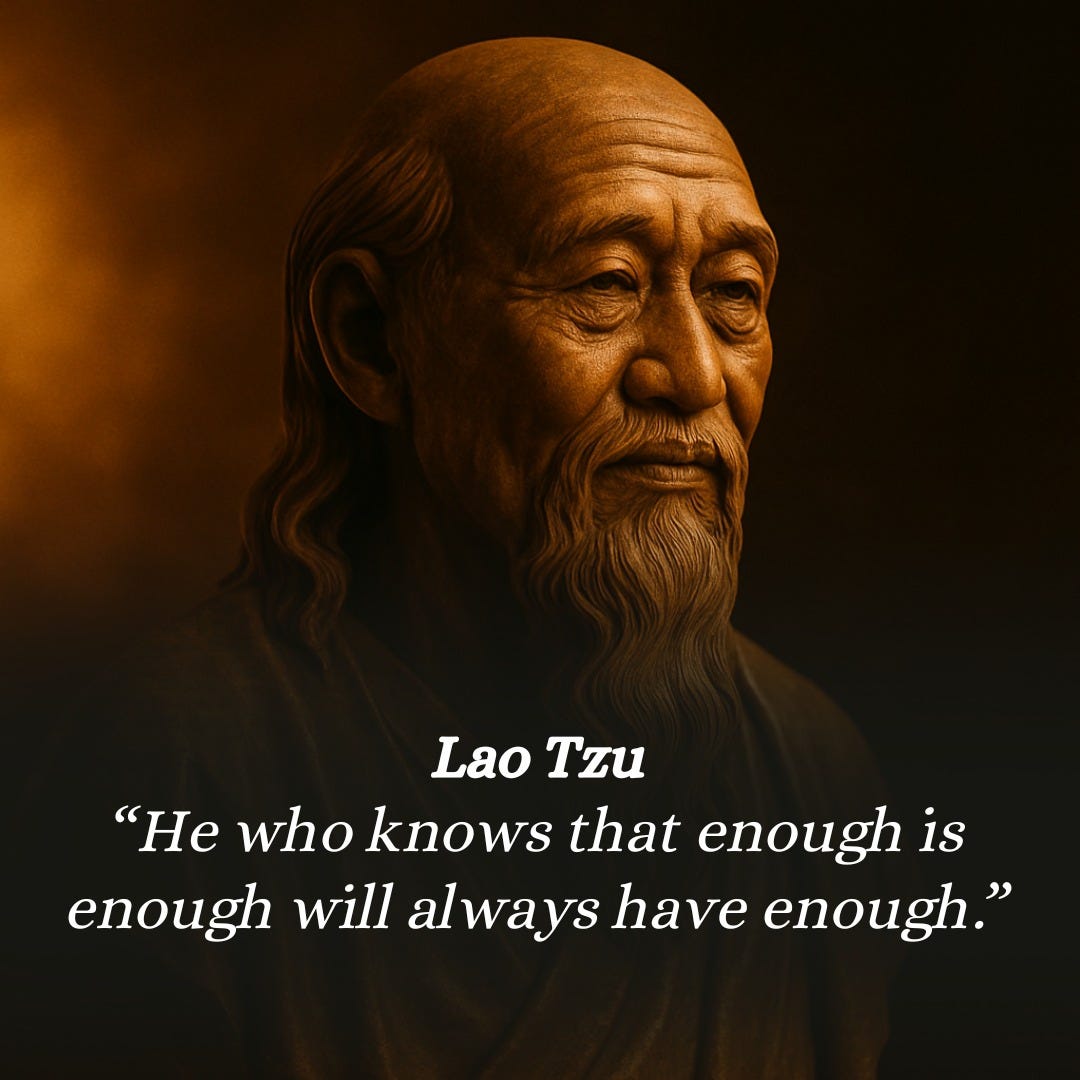
In Taoist philosophy, the Tao represents the underlying order of the universe—a natural flow that all things follow.
To live in harmony with it is to move with the rhythm of nature rather than against it.
As Bruce Lee famously expressed, to be aligned with the Tao is to be like water—yielding and formless, yet powerful, adaptable, and unstoppable.
“Empty your mind, be formless, shapeless, like water. If you put water into a cup, it becomes the cup. You put water into a bottle and it becomes the bottle. You put it in a teapot it becomes the teapot. Now, water can flow or it can crash. Be water, my friend.” - Bruce Lee
This is the most powerful philosophy I’ve encountered—across martial arts, business, politics, and investing.
No one can control the stock market—just as no one can command the ocean.
Without the right tools, technology, or wisdom, resisting its power is futile.
But when you see the tide turning, you can ride the wave. And if you ever become powerful enough—when you become water itself—you can choose to flow or crash.
Align with the Tao: The Stock Market
In investing, the Tao is the stock market.
The market, like nature, has its own rhythm—booms and busts, greed and fear. You cannot control the market, only align with its flow.
In practice:
Study cycles, liquidity flows, and sentiment — not to fight them, but to ride them.
Like a surfer waiting for the right wave, you wait for the market to present opportunity.
Don’t try to impose your will; adapt your positioning to the environment.
Effortless Action: Wu Wei
Effortless action, otherwise known as Wu Wei, is being harmonious with the Tao without force or resistance.
It is not passivity or doing nothing, but rather doing nothing unnatural. When paired with mastery — intuitive timing and ease achieves all that one looks to get done.
This concept is adjacent to the idea of flow — an athlete at peak performance without thinking, or a leader who leads by presence rather than force.
In investing, Wu Wei means acting when conditions are ripe and not forcing trades out of ego or fear of missing out.
“With effortless action, or sometimes non-action, everything is done.”
In Practice:
Trade less, but with precision.
Let positions compound rather than micromanaging every tick.
When volatility and liquidity align, then move decisively — but without emotional strain.
Modern parallel: The Taoist investor flows with the momentum at the right time. Ideally, they are ready for the wave before it starts. By doing so, they flow with asymmetry — entering when effort feels minimal and odds are maximal.
If the wave is about to end, they smoothly finish riding the wave, and then wait for the next one.
Yin and Yang — Embracing Duality
“Misfortune is the root of good fortune; good fortune gives birth to misfortune.” - Laozi
Be fearful when others are greedy, and greedy when others are fearful. - Warren Buffet
Markets move in cycles of optimism (Yang) and pessimism (Yin). The Taoist investor doesn’t cling to one polarity (bullish or bearish), but moves with balance.
In Practice:
Build strategies for both expansion and contraction. Know when to take long positions, have more cash, hedge or be in options.
Recognize that pain births opportunity — the best investments often arise from despair.
Integrate opposing forces — offense and defense — into one cohesive portfolio.
For example, if you had bought into the market index during major crashes—when prices approached the 200-week moving average—you would have been handsomely rewarded.
If you knew how to identify high-quality companies as the index reached those levels, you could have been financially set for life.
And if you understood how to position with options before crashes—or at the market’s true bottom—you could have built generational wealth.
Naturalness: Ziran — Investing True to One’s Nature
The sage rests in what is natural.
Every investor has a nature — temperament, time horizon, and circle of competence.
The Taoist investor doesn’t blindly imitate others’ methods or chase external validation.
In practice:
Find your domain: long-term macro, asymmetric bets, deep value, or innovation cycles.
Align your strategy with your psychological strengths and life energy.
Your portfolio should also express your own Tao, not just someone else’s playbook
Yes, learn from world-class teachers.
but remember—the highest path is to become your own sage, aligned with your nature and the Tao.
Emptiness and Stillness — Clarity Amid Noise
“Become totally empty. Quiet the restlessness of the mind. Only the nwill you witness everything unfolding from emptiness. - Lao Zi”
Noise and emotion fill most investors’ minds. Stillness and mental emptiness allows perception of patterns others miss.
Practical form:
Avoid constant information overload — filter the noise for signal.
Enter meditative and flow states that sharpen clarity and detachment.
Recognize that not trading too often is an action of strength.
Take decision action when the moment is right, guided by patience.
Non-Attachment: Relativity and Perspective
“In the end, the treasure of life is missed by those who hold on and gained by those who let go.
Short-term fluctuations are illusions; all things are relative to time and perception.
In practice:
Zoom out to the larger cycle — both in price and in your life’s timeline.
Don’t attach identity to market moves (e.g., “I was right” / “I was wrong”).
See profit and loss as parts of a larger whole — they teach balance.
This sounds absurd when you’re here to learn about investing, but if you study the philosophy of investing or trading legends, you see it in action often.
Takashi Kotegawa famously turned $13600 into $153 million in trading.
“The moment I think ‘I want to make money,’ I lose… Success brings arrogance. Arrogance brings ruin… The quieter my life is, the sharper my mind becomes.” - Takashi Kotegawa
Humble, Patient, and Free — The Sage Investor
“He who knows he has enough is rich.” - Lao Zi
The Taoist investor seeks freedom, not endless accumulation. They understand compounding as a reflection of nature’s quiet growth.
In practice:
Let wealth grow naturally, like a tree, not forced like an artificial crop.
Avoid arrogance; respect uncertainty.
Focus on right relationship with money — as energy, not identity.
Harmony with Uncertainty - Taoist Risk Management
To a Taoist investor, risk isn’t to be eliminated but harmonized with.
Volatility is the dance of Yin and Yang — it gives birth to opportunity.
In practice:
Be fluid and adaptive — preserve capital when it’s time to, and turn aggressive when the time is right.
By understanding the cycle of extremes, you are in harmony with uncertainty and capable to take advantage of it.
The Taoist Investor Ethos:
A Taoist investor moves with the rhythm of the market rather than against it — acting only when the moment is ripe and resting when it is not.
They seek balance between risk and patience, profit and preservation, guided by clarity instead of control.
Rooted in simplicity and aligned with their own nature, they let wealth grow as life does — quietly, naturally, and without force.